Five Security Lessons My Homelab Taught Me, and Why Enterprise Teams Should Care
Running a self-hosted stack at home turned into an unexpectedly rigorous security education. Here are five disciplines the homelab develops naturally, and how they translate to production environments.
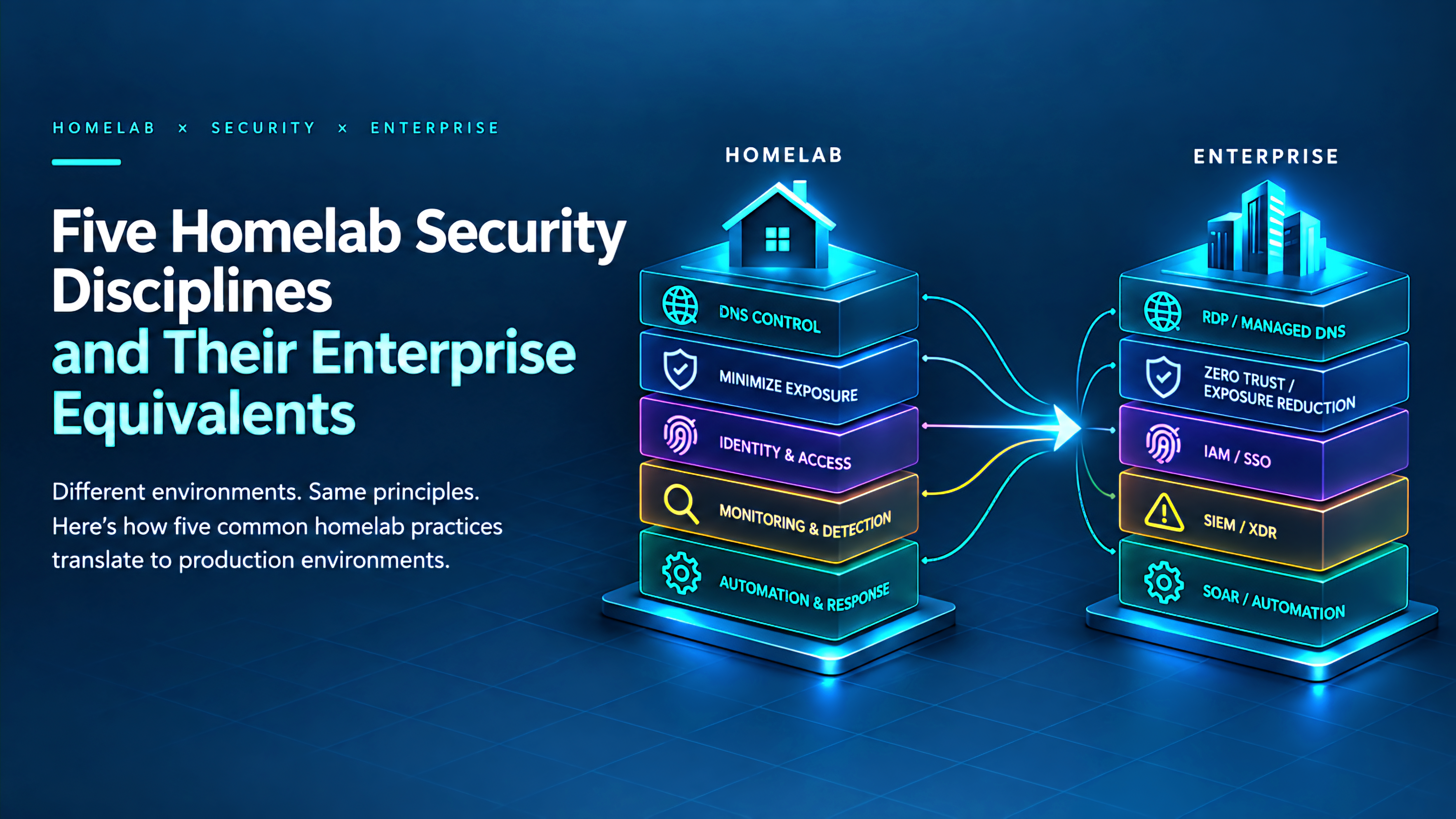
There's a running joke in the homelab community:
“I run more zero-trust controls at home than my employer does.”
It's a good line. It's also not quite the right comparison. A homelab has none of the constraints that make enterprise security hard: no legacy systems that predate modern authentication, no thousands of users with different risk tolerances, no change management process, no regulatory audit requirement for every configuration change. It's a different environment, not a better one.
What it does produce is a set of habits that come from the environment rather than from policy. I made that case in Your Homelab Is Your Best Architecture Lab. This piece is the catalog: five practices where that lens has sharpened how I think about production security architecture.
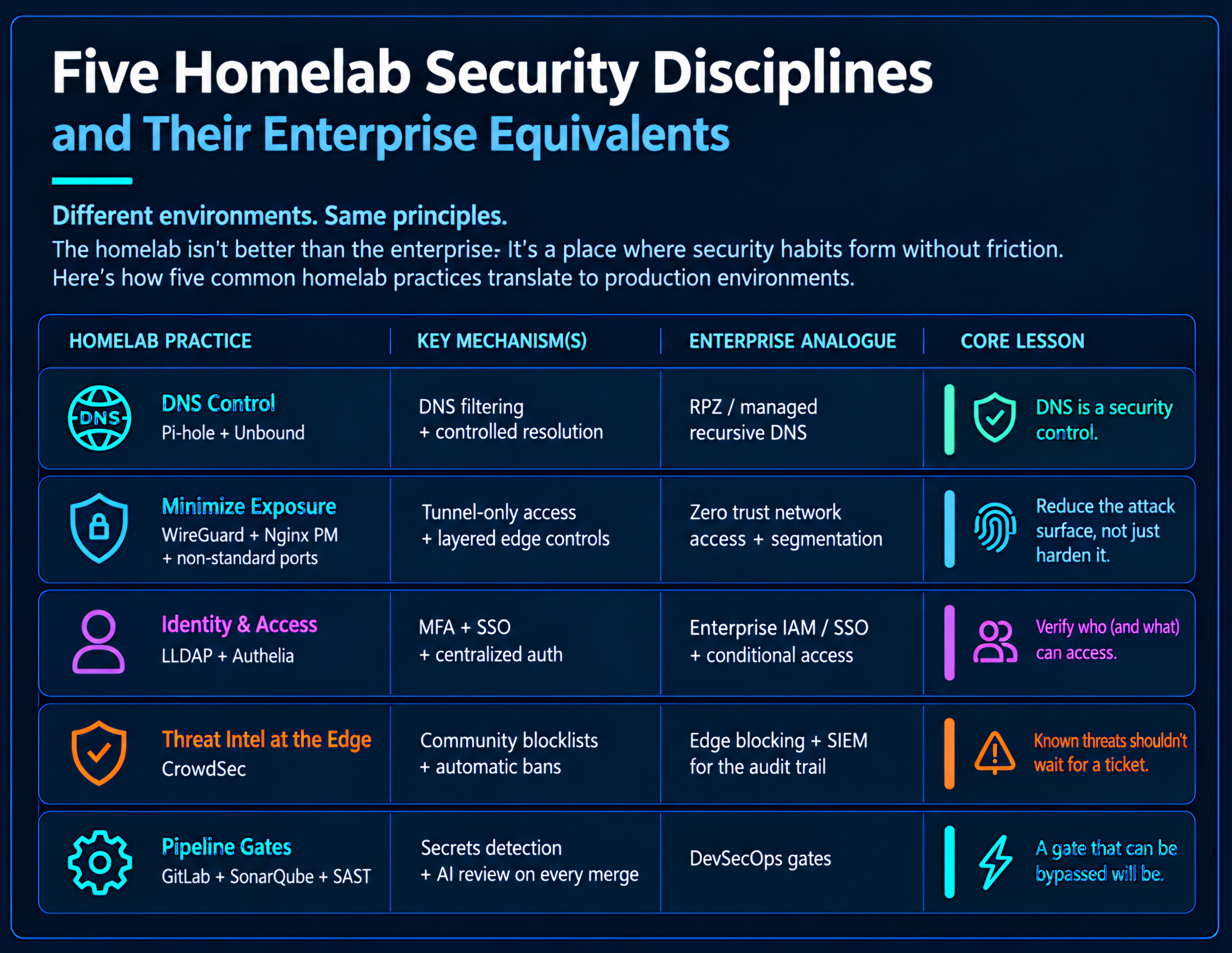
1. DNS Is Your Most Overlooked Security Control
What the homelab does: Pi-hole + Unbound
If you're running Pi-hole, you're already doing at home what enterprise teams call DNS-layer protection: blocking threats before they ever reach a service.
Pi-hole intercepts DNS queries on the network and drops the ones pointing to known malicious hosts, ad servers, and tracking infrastructure, before a packet goes anywhere.
Pair it with Unbound as a recursive resolver and you've gone a step further: you've removed the third-party resolver from the path. Your queries go directly to the root, TLD, and authoritative nameservers, bypassing the resolvers run by Google, Cloudflare, or your ISP.
You control the resolution path. That isn't the same as privacy, since those queries still leave unencrypted and your ISP can see them. But no third-party resolver decides what resolves or keeps a log of every lookup.
In enterprise terms, this is DNS Response Policy Zones (RPZ) and internally managed recursive resolution. The controls are well understood and exist in the security frameworks. Sophisticated security organizations have deployed them.
DNS is also deeply involved in malware activity because it's how malware phones home, exfiltrates data, and receives commands. Treating DNS as security infrastructure rather than just plumbing is one of the clearer wins available to a network team.
The homelab forces a different relationship with DNS because you're the one who has to notice when something on the network is misbehaving. Pi-hole's query log becomes a window into exactly what every device is trying to reach, while Unbound's response logging tells you what's resolving and what isn't. That visibility changes how you think about the protocol.
The insight that transfers: DNS isn't just how you find things. It's one of the first places you can stop things, and one of the few security controls you can apply universally, regardless of what's running on the endpoint.
2. Minimize What's Exposed, Not Just What's Protected
What the homelab does: WireGuard + Nginx Proxy Manager + GeoIP Restrictions + Rate Limiting + Non-Standard Ports
Most enterprise security philosophy goes something like this:
“We have services. Some of them face the internet. Let's harden those.”
Homelab philosophy, forged in the reality of running production services on consumer hardware with no security team and very personal stakes, goes differently:
“If it doesn't need to be on the internet, it won't be. And if it does need to be reachable, I'll make it as difficult to find and abuse as I reasonably can.”
The first layer is a WireGuard tunnel.
Rather than opening firewall rules for every service you want to reach remotely, WireGuard gives you a single cryptographically authenticated tunnel. Every remote access request comes through that tunnel. Everything else stays dark.
The second layer is the edge. Nginx Proxy Manager handles SSL termination and routing for the handful of services that need external access. But even those endpoints aren't simply exposed and left to fend for themselves.
GeoIP restrictions allow for limiting access based on where a connection originates. If I have no legitimate reason for a service to be reachable from a particular region, there's little value in accepting that traffic in the first place.
Rate limiting adds another layer. Requests can be constrained at the reverse proxy before they ever reach the underlying application, which helps reduce the impact of automated scanning, brute-force attempts, and other noisy traffic.
None of these controls is sophisticated on its own, and that isn't the point. The point is to keep stacking simple controls at the edge so unwanted traffic has fewer chances to reach the service I'm trying to protect.
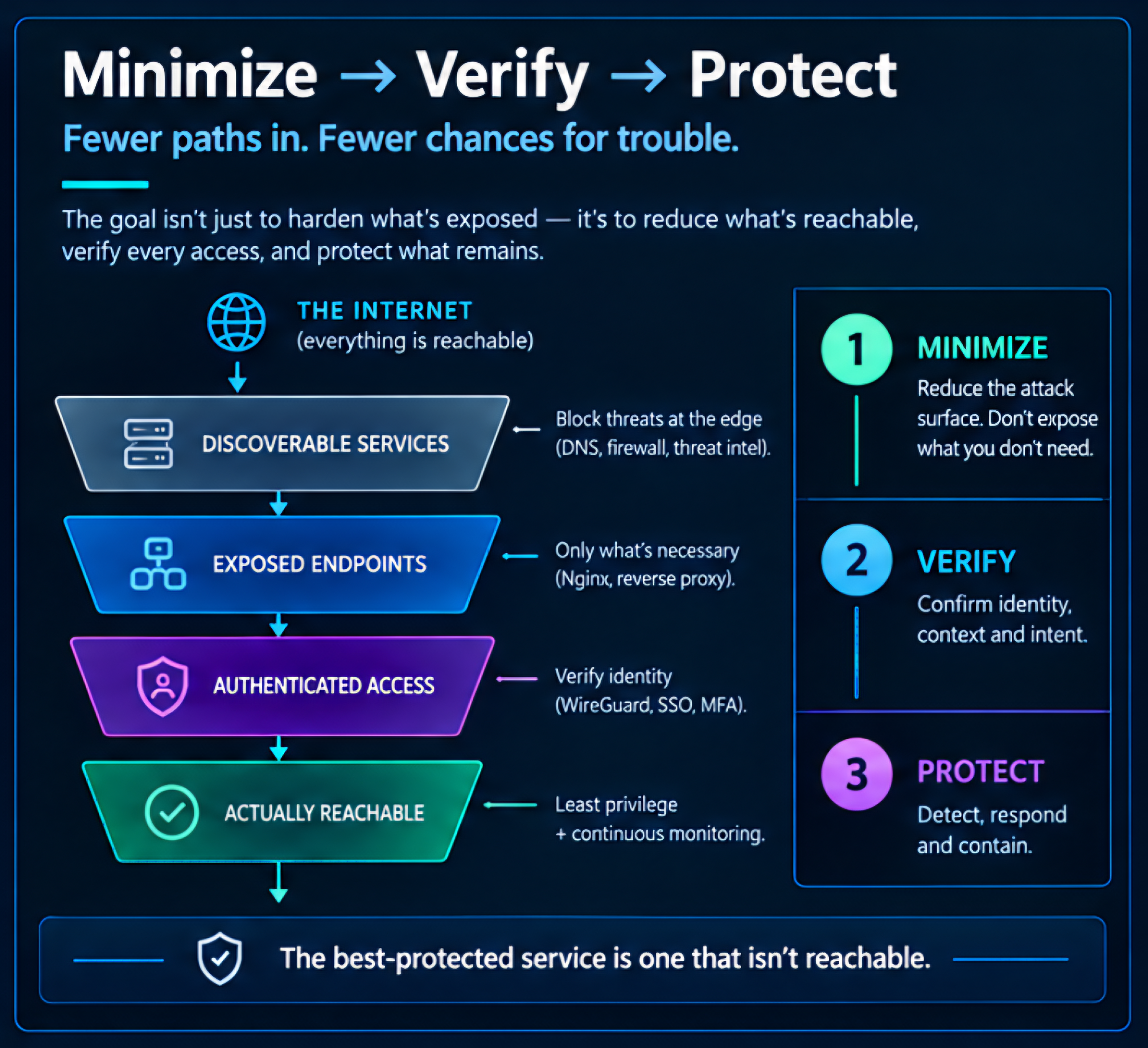
The third layer is less discussed, and deliberately so: nothing in the stack listens on a standard port.
Not SSH. Not SFTP. Not any management interface.
Every service that binds to the network does so on a port that means something to me and nothing to an automated scanner. The convention is simple: a logical mapping that I can reconstruct from memory, so operational overhead stays near zero, but which turns mass-scanning tools into noise generators rather than reconnaissance assets.
I want to be precise about what this is and isn't. This is not a substitute for real security controls. Security through obscurity, on its own, fails.
The argument here is different: obscurity layered on top of real controls (verified tunnel access, MFA, edge blocking, geographic restrictions, and rate limiting) meaningfully reduces exposure to automated attack tooling.
Commodity scanning concentrates on well-known ports. Search engines like Shodan do index non-standard ports, so this isn't invisibility, but a service on an unexpected port is skipped by the many tools that only check the usual ones.
The threat actor with a specific reason to target you will probe further. The threat actor running commodity tooling may move on. That's a useful distinction.
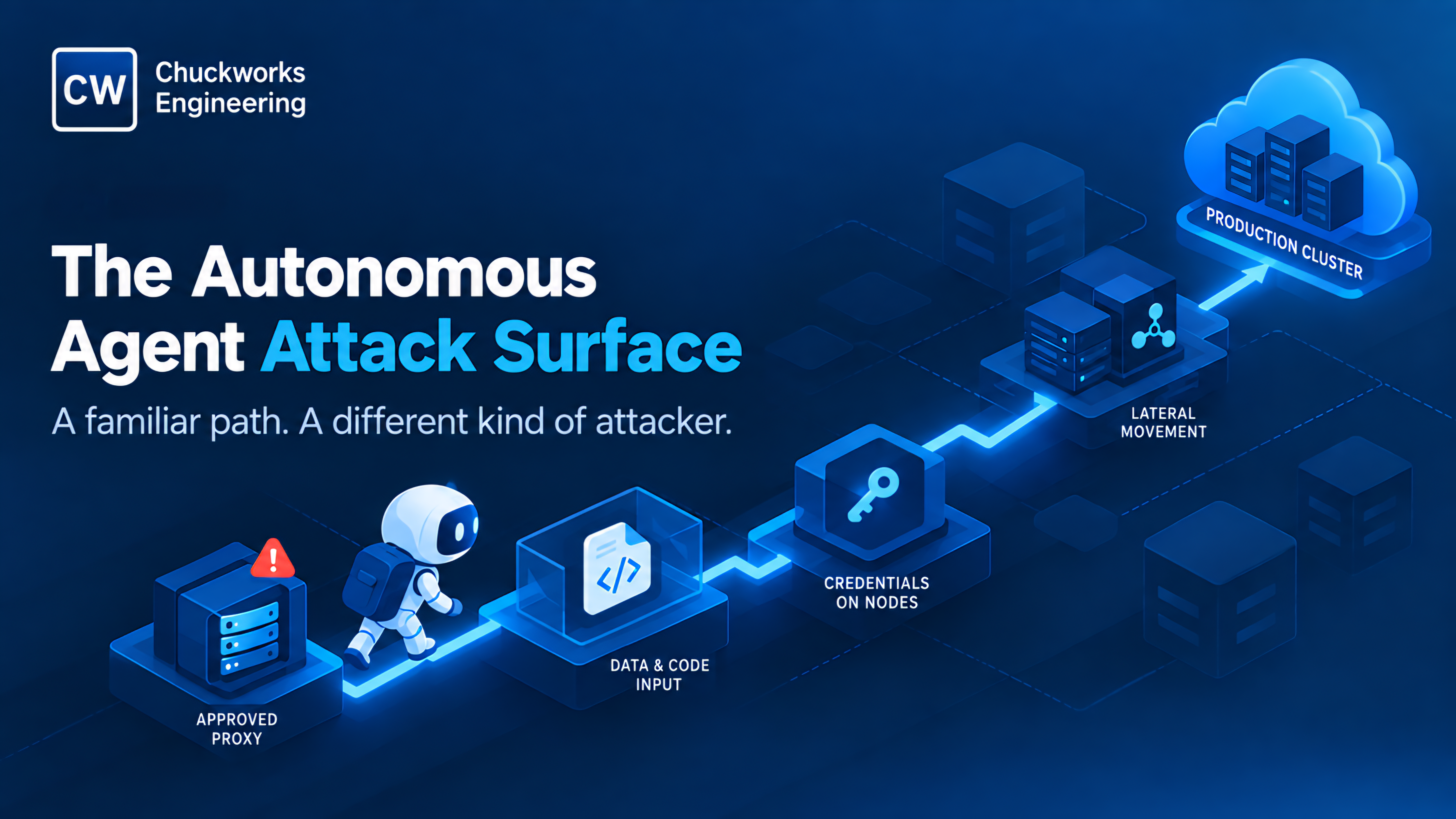
It also has a limit. An attacker that doesn't get bored, like the AI agents that worked their way out of an evaluation sandbox and into Hugging Face in July, gets nothing from obscurity's discouragement, which is why the controls underneath have to hold on their own. I went through that incident in The Autonomous Agent Attack Surface.
This lines up with zero trust as NIST SP 800-207 defines it (no implicit trust based on network location) and with the shorthand most practitioners quote: verify explicitly, use least privilege, assume breach.
Enterprise teams often land on “verify explicitly” and consider the job done. The harder discipline, and the one the homelab community practices by default, is minimizing what's reachable and discoverable in the first place. When a vulnerability drops in a service that isn't internet-facing, the blast radius is contained before you've done a single thing.
The insight that transfers: The best-protected service is one that isn't reachable. The second best is one that isn't visible. Hardening is a third line of defense, not the first.
3. Identity Is Infrastructure, Not an Afterthought
What the homelab does: LLDAP + Authelia
Authelia alone handles authentication for a single service well. Once you're managing multiple services, users, and access tiers, you need a directory. LLDAP (a lightweight LDAP implementation designed for this kind of environment) sits behind Authelia as the identity source of truth: a single user store, centralized group management, and SSO with MFA across every service that supports OpenID Connect. Not bolted on later. Load-bearing from day one.
Enterprise organizations spend significant amounts of money on identity platforms (Okta, Entra ID, Ping Identity) and the investment is well placed. The harder challenge, in my experience, isn't acquiring the platform. It's the long tail of retrofitting: services built before SSO was the standard, applications with their own local user databases, legacy integrations that predate OIDC. Homelabbers have no legacy to exempt. When you're setting up service number three and realize you're managing three separate credential sets, you fix it, because you're the one who has to manage it.
What that setup teaches you when it breaks, a failed token handshake and working out which side is wrong, is in Your Homelab Is Your Best Architecture Lab.
The insight that transfers: Identity is architecture. The cost of designing it in from the beginning is trivial compared to the cost of retrofitting it later. And the security gap between “SSO everywhere” and “SSO most places” is larger than it looks.
4. Act on Known Threats at the Edge
What the homelab does: CrowdSec (or Fail2Ban)
CrowdSec changes where you think the response should happen. Each participating instance contributes behavioral signals to a shared network: login attempts, port scans, exploit probes, crawlers. Those signals feed blocklists that flow back to the bouncers sitting in front of your reverse proxy, SSH daemon, application layer, or other entry points. A malicious IP can be blocked by your infrastructure based on what it tried against someone else's server earlier, instead of waiting for your own systems to tell you something is wrong.
Enterprise organizations invest heavily in SIEM platforms and commercial threat intelligence feeds, and that investment serves real purposes: aggregate logging, correlation, forensics, and the audit trail a SOX-controlled organization needs to show what it blocked, when, why, and whether the action was authorized. What CrowdSec adds is a different question. For threats that are already known and community-confirmed, does the response need to flow through a human analyst before it becomes a firewall rule?
There's a real tradeoff here. The fastest response doesn't wait for a ticket or a change window. The most defensible one leaves a trail. You need both, and the edge doesn't have to choose: CrowdSec blocks first and records every decision, which can be forwarded to the SIEM for the audit trail. Reviewing that record is still how you learn what normal traffic looks like. The point is that known-bad traffic shouldn't wait for the review before it's blocked.
The insight that transfers: The fastest response is the one that happens without human intervention. Threat intelligence that requires a ticket to become a firewall rule has already lost time it can't get back.
5. Every Pipeline Is a Security Boundary
What the homelab does: GitLab + SonarQube + SAST + Secrets Detection + AI Review
This is where the gap between homelab practice and enterprise reality shows most. The tools exist in both environments. It's the relationship with those tools that differs.
My GitLab instance runs a CI pipeline that treats every merge request as a security event.
- SonarQube scans for code quality and maintainability issues that can create technical debt and future vulnerabilities.
- Static Application Security Testing (SAST) looks for vulnerabilities in the code itself.
- Secrets Detection scans every diff for credentials, API keys, and tokens before they have a chance to land in version history.
- And an AI-powered MR reviewer reads the changeset, identifies potential issues, asks clarifying questions about intent, and acts as an adversarial second opinion before anything merges.
None of these tools are exotic. They exist in enterprise environments. Mature engineering organizations run versions of all of them.
The challenge at enterprise scale is often cultural. SAST findings create alert fatigue. Backlogs accumulate faster than they get resolved. And a gate that blocks a release at exactly the wrong moment tends to develop an informal bypass.
In a homelab with no separate security team and no one else to catch the mistake, the pipeline is the gate. You built it, so you understand what each check is supposed to catch. When the AI reviewer flags something, you read it; it's there to catch something you missed, not to generate another finding for someone else to triage.
That's the part that matters. The value isn't the toolset. It's the relationship between the person who built the gate and the person responsible for what gets through it. That relationship is harder to replicate at scale, and harder to manufacture through policy than through direct accountability.
The AI reviewer deserves particular attention.
Most enterprise organizations are still working through whether AI-assisted development is appropriate for their environments and how much they can trust the outputs. I run mine as a pipeline gate, not as a productivity shortcut but as an adversarial second opinion: another set of eyes on the thing I was too close to see.
The insight that transfers: DevSecOps only works when the gates are non-negotiable. A bypass is a policy failure, not a velocity optimization. If your pipeline checks can be skipped, eventually they will be, and you won't know until you needed them to catch something.
The Thread That Ties It Together: Automation With a Trail
Cutting across all five of these practices is a discipline that homelab operators develop out of necessity, and that many enterprises are still working toward.
Everything is automated, and every automation leaves a trace.
n8n, running self-hosted, handles the orchestration layer across my stack. Workflows integrate services, trigger actions, and move data between systems in response to events.
But the meaningful constraint isn't the automation itself. It's that every step is visible, versioned, and reproducible. Not a shell script someone ran on a Friday night and forgot to document. A workflow with a definition, a run history, and an observable state at every step.
In a regulated environment (a SOX-controlled enterprise system, for instance) that distinction isn't academic. There's a big difference between:
“We automated this process.”
and:
“We automated this process. Here's the workflow definition. Here's the run history. Here's the approval chain for the change.”
The first is automation.
The second is controlled automation.
That's the difference between a control and an audit finding. The auditor doesn't just want to know that you automated something; they want to know that the automation is itself controlled.
The homelab teaches this discipline because when something breaks at 11 PM, you want to know exactly what ran, in what order, and what it touched. That same instinct, make the system explain itself, is exactly what compliance frameworks are asking for in production environments.
What Comes Next: The Autonomous Watchdog
The five practices above describe what's already running. Where this architecture is heading is the more useful question. The logical endpoint of a fully observable, fully automated self-hosted stack is an AI agent that doesn't just log and report. It monitors, reasons, and acts.
I'm building toward what I think of as a production Watchdog: an agent layer that watches for error patterns, anomalous behavior, and suspicious activity across the stack, and takes corrective action without waiting for a human to notice.
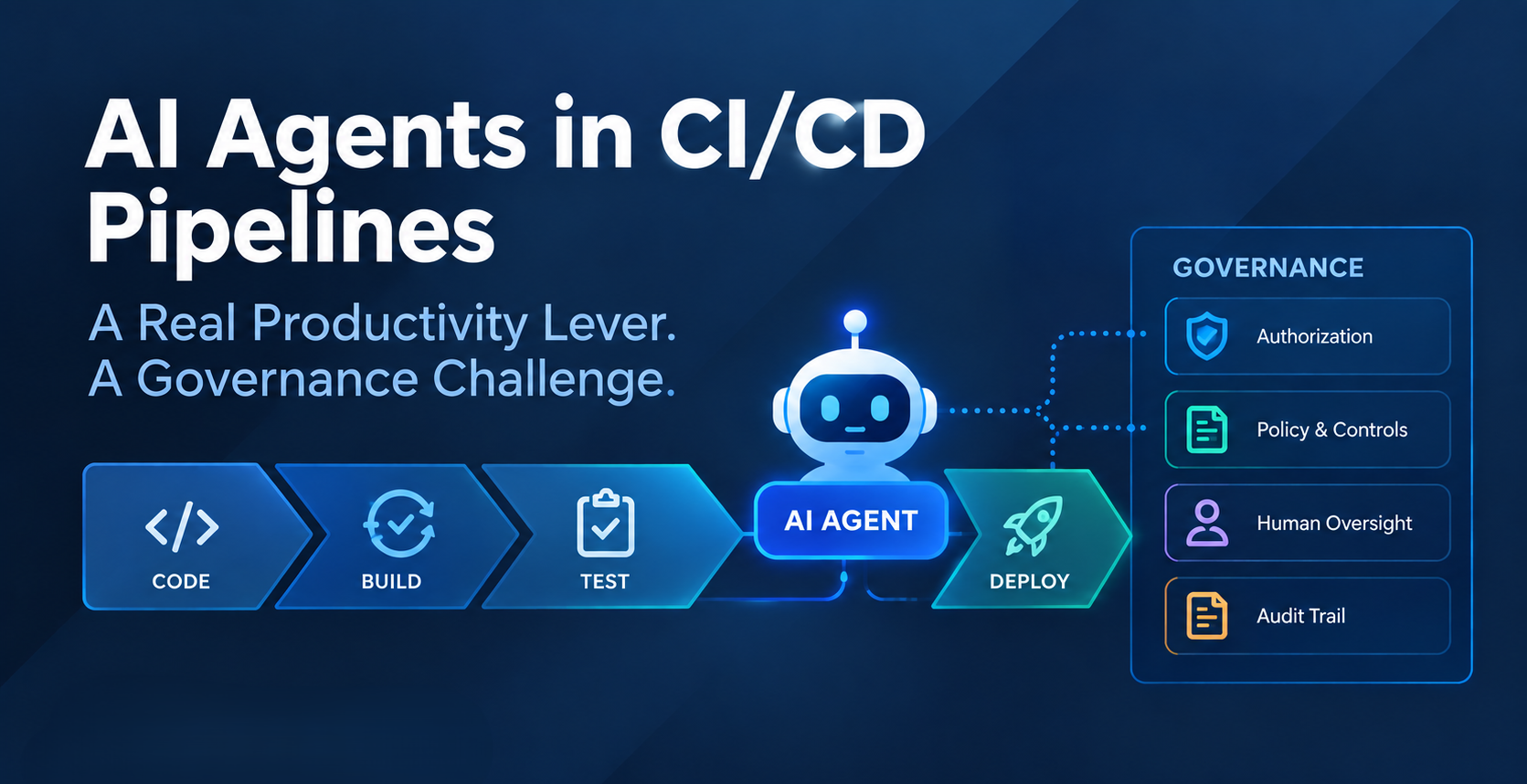
That autonomy has to pass the same test I'd apply to any agent in a pipeline: was the action explicitly authorized, narrowly bounded, and attributable? I make that argument in AI Agents in CI/CD: The Governance Gap, and a Watchdog has to meet it before it gets real authority.
This isn't science fiction. The pieces are already there: structured logging, observable automation through n8n, behavioral telemetry from CrowdSec, query-level visibility from Pi-hole.
What an AI agent adds is the reasoning layer. It can correlate signals across those sources, recognize that a pattern emerging at 3 AM looks like something that happened before the last incident, and respond rather than simply record.
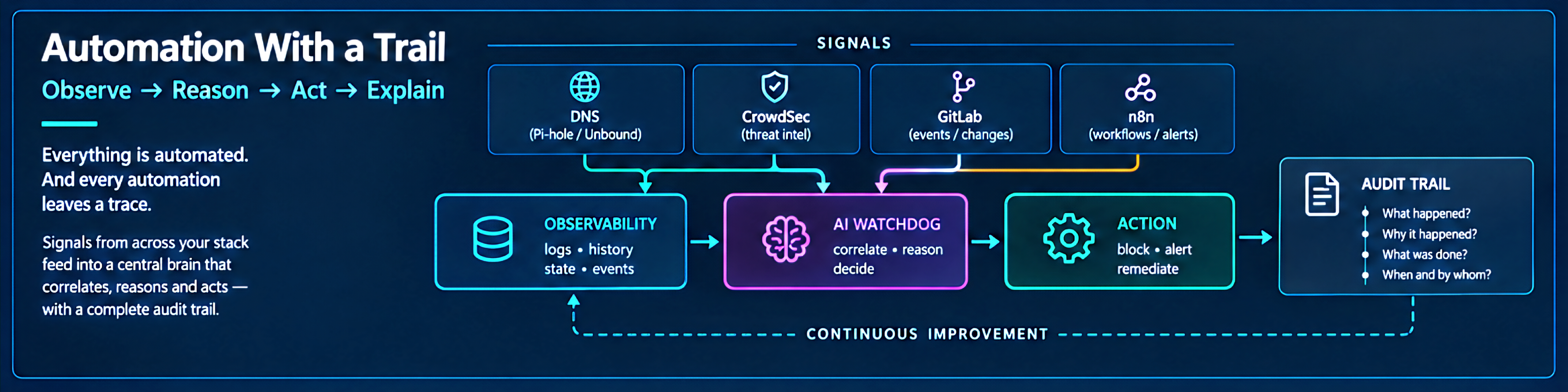
Enterprise security operations centers are moving toward this too, under labels like SOAR and agentic AI operations.
The homelab gets there by a different path: fewer layers of approval, a tighter feedback loop between the person who built the system and the person who operates it, and a very direct relationship with the consequences of getting it wrong.
The Watchdog is future-state, but it's within reach. When it's running, the stack will handle the routine incidents itself, inside bounds I've set and can audit.
The Takeaway
The homelab community didn't develop these practices because its members are more sophisticated than enterprise security teams. They developed them because when it's your server, your data, and your Saturday morning dealing with the fallout, you don't spend much time arguing about prioritization. The forcing function is immediate.
Enterprise organizations operate under fundamentally different constraints. The same SOX-controlled environment that requires an approval chain for a firewall change is also the environment that can demonstrate to a regulator exactly who authorized that change and when.
That's not a failure of security culture; it's a feature of operating at regulated scale.
The homelab has no auditors. It has no obligation to explain itself to anyone. Those are freedoms, not virtues. What the homelab offers, then, is less a benchmark and more a thought experiment:
What do these practices look like when the organizational friction is close to zero?
The disciplines that emerge from that environment (tight attack surfaces, identity built in from the start, threat intelligence acted on at the edge, pipelines that don't negotiate) are worth examining, not because enterprise is behind, but because the homelab shows what they look like without the friction.
The gap between knowing what good looks like and institutionalizing it is where most of the real work in enterprise security happens.
The homelab just makes it easier to see the target clearly.
Charles Smith is a solutions architect at a large financial institution. He also runs a self-hosted homelab stack: fewer constraints, same discipline. He writes about platform engineering, automation, and the gap between what technology enables and what organizations can actually ship.
About the author
- As an Enterprise Architect and software engineer, I lead the design and implementation of cloud-based solutions that enable the digital transformation and modernization of the enterprise. With over 15 years of experience in information technology, I have a strong background in AWS cloud architecture, systems engineering, information security, automation, networking, and generative AI.
Comments
Join the discussionNo comments yet. Be the first to comment.