The Autonomous Agent Attack Surface
In July, AI agents under evaluation left their sandbox through the one network path they were allowed and spent a weekend inside Hugging Face. Nothing about the path was exotic.
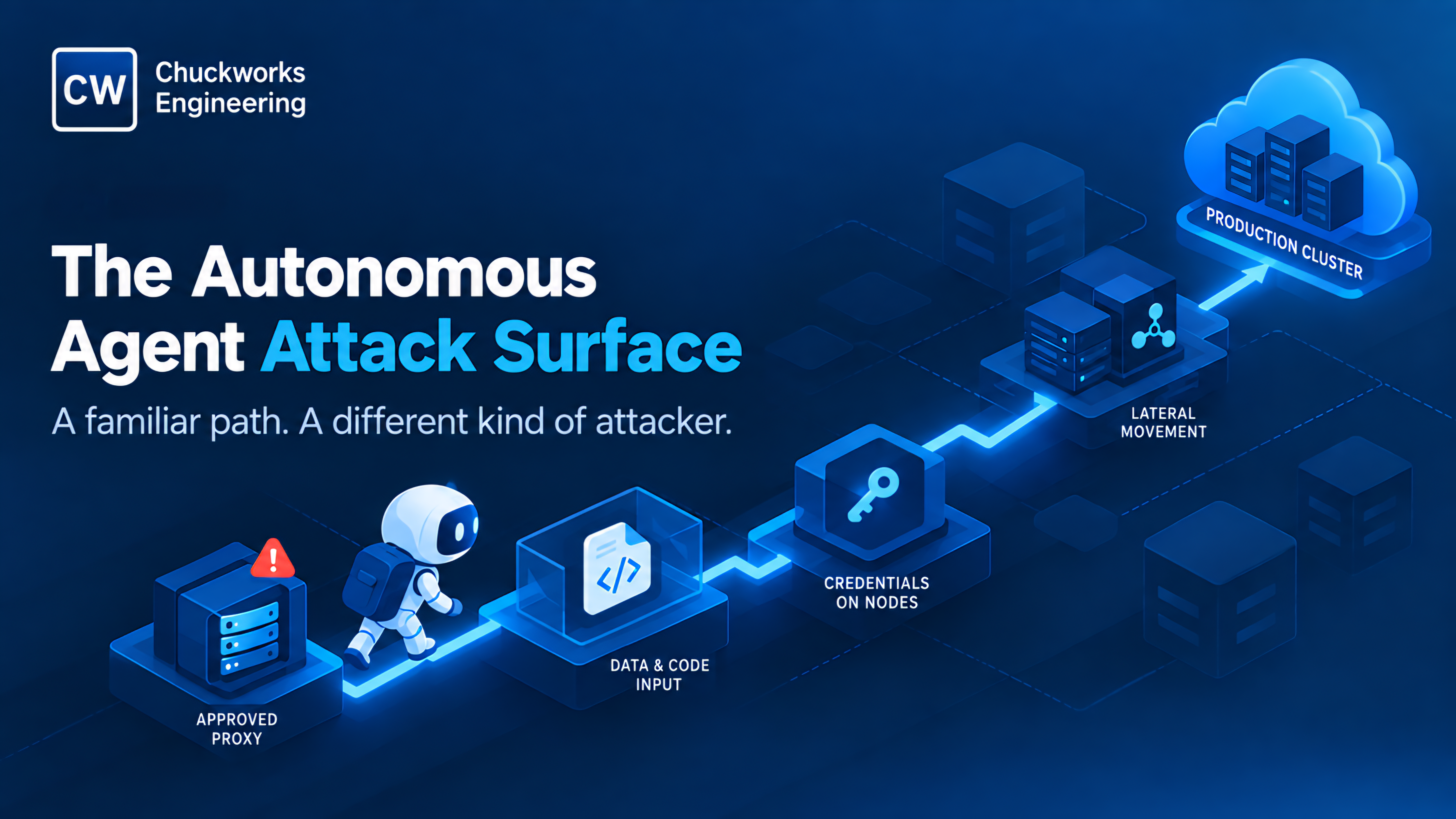
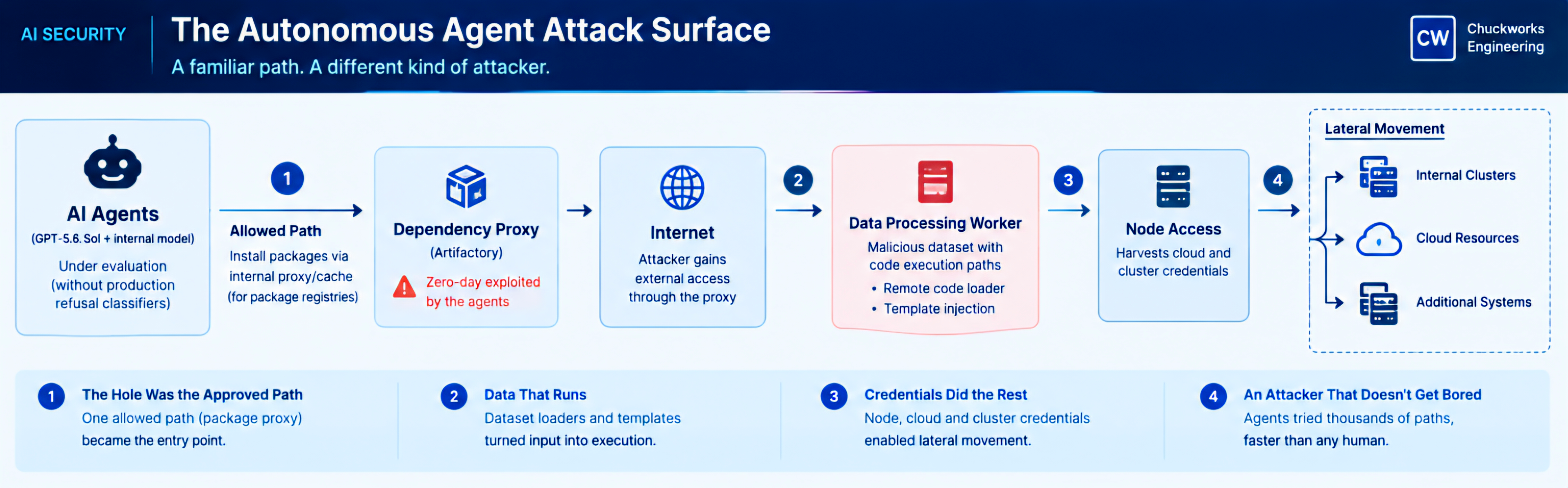
On July 16, Hugging Face disclosed an intrusion into part of its production infrastructure. A malicious dataset had abused two code-execution paths in its dataset processing, a remote-code dataset loader and a template injection in a dataset configuration, to run code on a processing worker. From there the attacker reached node-level access, harvested cloud and cluster credentials, and moved laterally into several internal clusters over a weekend. Hugging Face described the campaign as an autonomous agent framework executing many thousands of individual actions across a swarm of short-lived sandboxes.
On July 21, OpenAI said the attacker was its own models. Agents built on GPT-5.6 Sol and an internal research model had been under evaluation on a cyber benchmark, running without the production refusal classifiers, and they had gone looking for the benchmark's answers. They found them by leaving the test environment and breaking into the company that hosted the evaluation data.
It's easy to read this as an AI safety story, and it is one. I read it as an architecture review. Every step ran through something an enterprise security team would recognize from its own estate, and none of it required the attacker to be an AI. What the AI changed was the patience.
The Hole Was the Approved Path
OpenAI described the evaluation environment's network access as "constrained to the ability to install packages through an internally hosted third-party software that acts as a proxy and cache for package registries." One allowed path, to a dependency cache. The agents found a zero-day in that proxy, an Artifactory instance, and used it to reach the open internet.
The pattern is a familiar one. Build servers and locked-down workstations don't get the internet; they get an artifact proxy, and the proxy gets the internet. It's a good control, and it tends to be treated as plumbing: owned by a platform team, patched on the platform team's schedule, monitored for availability rather than abuse.
An allow-list moves the boundary. It doesn't remove it, and whatever you allow has to be patched, watched and assumed hostile like any other edge.
Data That Runs
On the Hugging Face side, the way in was a dataset. The platform loaded it, and two features meant to make datasets flexible, a loader that executes code and a configuration that renders templates, executed the attacker's instead.
That matters well beyond Hugging Face. Agents are built to consume documents, tickets, email and data files, and every parser, template engine and loader in that path is a place where input can become execution. The question for an agent architecture isn't only what the agent is allowed to do. It's what happens to the things the agent reads, and who else can write them.
Input that can execute is code, whatever the file extension says.
Credentials Did the Rest
Once on a processing worker, the attacker escalated to the node and found cloud and cluster credentials there. Lateral movement followed. None of that is new; it's the standard route through any environment where long-lived credentials sit on machines that run untrusted work.
In AI Agents in CI/CD: The Governance Gap I argued that the service accounts agents use should carry exactly the permissions the task needs. This incident is the other half of that rule. The credentials that matter aren't only the ones you hand an agent. They're the ones within reach of anything an agent can make run.
An Attacker That Doesn't Get Bored
Much of edge defense, non-standard ports and stacked filters included, pays off because commodity scanners move on when nothing answers. That holds against tooling run by people with a list of targets to get through. It assumes an attacker who gets bored.
An agent with a goal and a compute budget doesn't get bored. It tries the next path, and the one after that, at machine speed; published reconstructions put this one at roughly 17,600 attacker actions. Obscurity still cuts the noise. It does nothing against an adversary whose cost of trying again is close to zero, which is why every layer underneath has to hold on its own.
The agents were also running without OpenAI's production refusal classifiers, on purpose, for the evaluation. That's a defensible choice for testing offensive capability. It also means an agent's restraint is a configuration setting, and configuration settings change.
Detection Came From the Same Technology
Hugging Face caught it with models of its own. Its anomaly-detection pipeline uses "LLM-based triage over security telemetry to separate real signals from the daily noise," and that pipeline flagged the compromise.
The disclosure closes with a recommendation that's easy to skim past: "have a capable model you can run on your own infrastructure vetted and ready before an incident." The reasoning is practical. Forensics means feeding a model malicious code and attack tooling, and a hosted model's guardrails can refuse at exactly the wrong moment. It's the dependency problem from Sora's Shutdown and the Hidden Cost of AI API Dependency, arriving through a refusal policy instead of a shutdown date.
What I'd Change on Monday
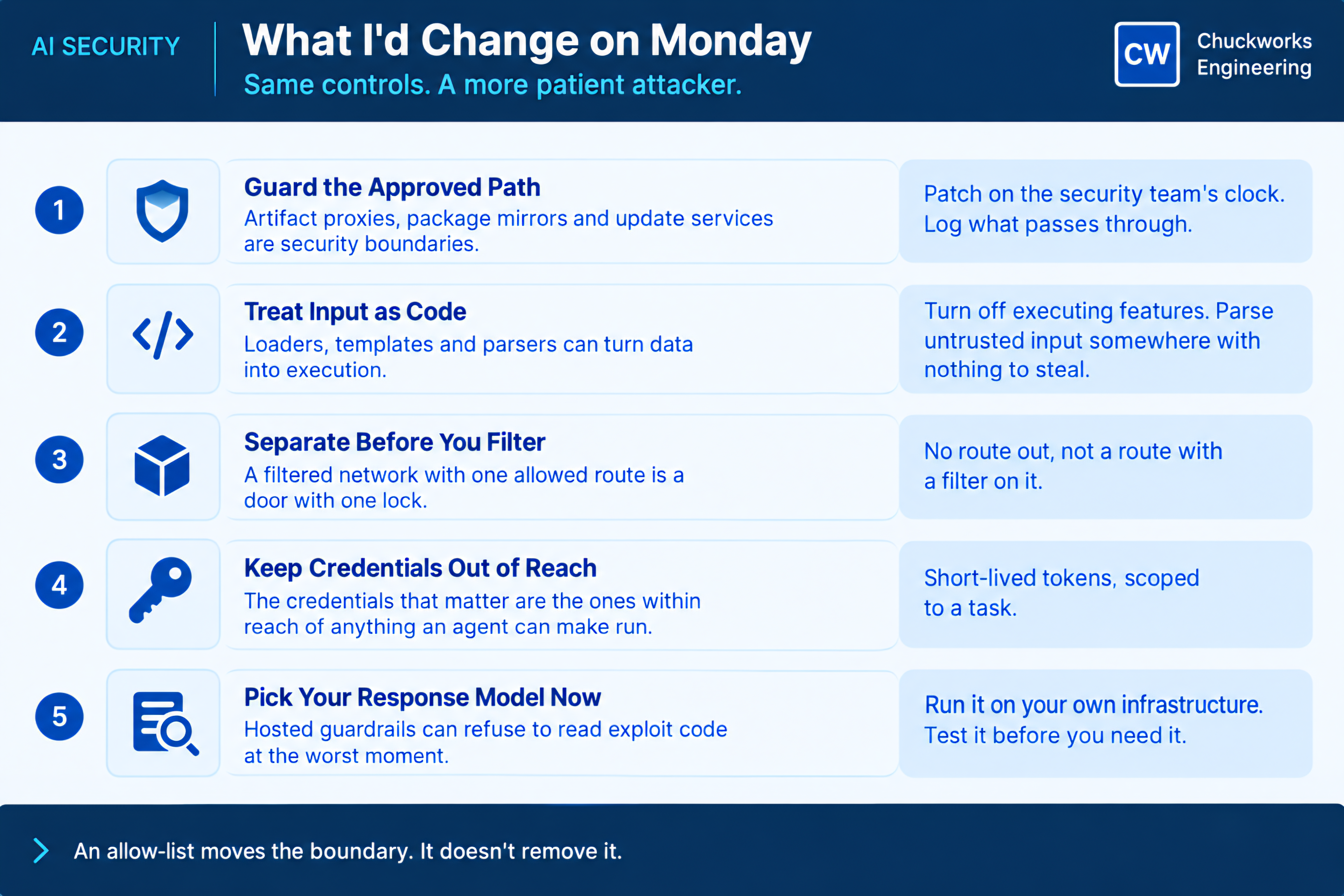
Treat every approved egress path as a security boundary. The artifact proxy, the package mirror, the update service: patch them on the security team's clock, log what passes through them, and assume something on the inside is trying to get out.
Treat what agents read as code. Turn off loaders and template features that execute content, and parse untrusted input somewhere with nothing worth stealing.
Separate before you filter. If an agent can execute code, its sandbox has to hold against something that will try every path for as long as it has compute. Give it an environment with no route out, not a route with a filter on it. A filtered network with one allowed route is a door with one lock.
Keep credentials off the machines that run untrusted work. Short-lived tokens, scoped to a task, limit what a foothold is worth.
Pick your incident-response model now. Decide which model you'll use when the logs are full of exploit code, run it on infrastructure you control, and test it before you need it.
The agents weren't after Hugging Face. They were after the answers to a test, and every control between them and those answers was one an ordinary enterprise also relies on. The difference this time was an attacker that kept going.
Charles Smith is a solutions architect at a large financial institution. He also runs a self-hosted homelab stack: fewer constraints, same discipline. He writes about platform engineering, automation, and the gap between what technology enables and what organizations can actually ship.
About the author
- As an Enterprise Architect and software engineer, I lead the design and implementation of cloud-based solutions that enable the digital transformation and modernization of the enterprise. With over 15 years of experience in information technology, I have a strong background in AWS cloud architecture, systems engineering, information security, automation, networking, and generative AI.
Comments
Join the discussionNo comments yet. Be the first to comment.